The Blind Leading the Blind
22 April 2008
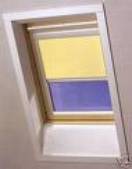
We have several Velux skylights in the house, some of which we fitted with Velux blinds when we moved in, only to find that the reliability of these blinds seems to be an issue. Until last week, we had had four new ones (one a replacement for one that failed under guarantee) and all but one went wrong within two years.
Teresa and Jay have, therefore, struggled with faulty ones for over three years as Roger was reluctant to order more. However, the alternatives are limited, and he recently agreed to give them another chance. Two more were ordered.
Teresa and Jay’s joy at the prospect of dispensing with the array of wedges, Blue-tak and parcel tape required for the old ones was unconfined.
Yesterday we set to work to install the first. We had, after all, fitted four before without any problems and the new blind should slot in easily when the old one came out. Imagine our disappointment when, on the verge of finishing the job, the blind fell out of its frame and finished dangling limply miles from the window.
Only the prospect of an unpleasant phone call to the supplier drove us to contemplate what we did next: we thought we could repair this marvel of precision engineering ourselves (actually we were calling the blind something rather less flattering by then).
It seemed, we thought, to be a matter of re-tensioning a spring deep inside the roller, then fitting it back in the frame without losing the tension and re-attaching it to the mounting on the window. Tension was imparted by turning a small lug with pliers, or, eventually, as a surer if more painful option by using fingers – Teresa took on this job. It then had to be held firm while inserting it into the frame, but it was impossible to get it in the frame without letting go and the spring would lose all its tension. This little sequence was replayed for over half-an-hour.
Roger – not a great fan of Velux blinds, as you will have gathered – was quite ready to give up, but, as time went on, Teresa made the discovery that the spring could be locked in place, thus keeping its tension without the need to hold it. And Roger discovered that the clamps on the frame could be removed, making the thing much easier to slot in, and also to re-roll the blind itself, which needed to be put up in the rolled state.
Even so, further trial and error was necessary before the blind finally went back and worked. In fact, we have not got the tension on the spring quite right, and will need another go some time, but that’s for the future.
Teresa deserves a medal for persistence, and, eventually, for penetrating the inner workings of the blind (as we say in the family). We hope her fingers recover quickly. Roger thinks he made one or two important observations, but, in truth, our progress was more or less exactly what it says in the title but we did get there in the end.